Our approach to prevention
This page outlines our proactive approach to improving public administration to reduce the risk of injustice. It is founded in our legislative functions and directly supports our Strategic plan 2025–29.
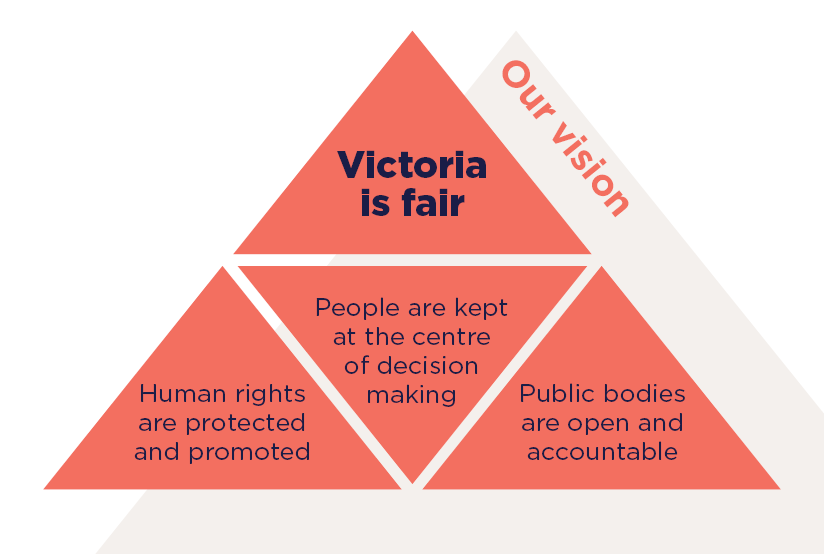
The Victorian Ombudsman exists to promote equity in what is an inherently unequal relationship between individuals and the State. Our vision is for fairness, and our goal is to protect and promote human rights. While independent and impartial, we can both amplify unheard voices and be a partner in good governance; shining a light on public interest issues and helping the public bodies we oversee to improve.
While we will always investigate and informally resolve complaints, we also work to stop problems arising in the first place. Prevention is a crucial part of our purpose and we are deliberately investing in it to realise our vision that Victoria is fair.
We believe that preventing harm before it happens is the most powerful way to protect rights, to build trust and to strengthen integrity across the public sector.
Prevention for us is not just about avoiding mistakes or misconduct; it’s about shaping a culture of accountability and continuous improvement. It means promoting what works, supporting public bodies to learn from complaints, and helping people navigate complex challenges before they escalate.
It also means being visible in the community, accessible to those who need us most, and engaged with the issues that matter.
In an increasingly complex and fast-paced world, where integrity risks can emerge quickly and the consequences can be far reaching, prevention is not a luxury, but a necessity. It’s how we shift from reacting to problems, whether isolated or systemic, to solving them at the source.
This paper outlines how the Victorian Ombudsman seeks to lead that change, by identifying risks early, engaging meaningfully, understanding context, educating the public and public sector alike, partnering on solutions and sharing information with clarity and impact.
The pages that follow outline our proactive approach to preventing maladministration and improper conduct by fostering integrity, promoting ethical behaviour, and strengthening complaint-handling mechanisms across Victoria’s public sector. In undertaking this work, we seek to build upon lessons learned from our operational work, stakeholder feedback and emerging trends.
We look forward to working with our stakeholders across the public sector and community to implement this framework and create lasting positive change.
Our objectives
This paper outlines our proactive approach to improving public administration to reduce the risk of injustice. It is founded in our legislative functions and directly supports our Strategic plan 2025–29.
We view our approach through a simple and powerful lens:
Promote the good. Prevent the bad. Expose the unfair.
Our prevention work is grounded in three key objectives of the Ombudsman Act 1973:
- To identify, expose and prevent maladministration and improper conduct.
- To assist public bodies to improve the quality of their administration and complaint handling.
- To educate the Victorian community and public sector about Ombudsman matters
These objectives define our role as both a watchdog and a steward – protecting rights, upholding standards, and supporting a culture of everyday integrity.
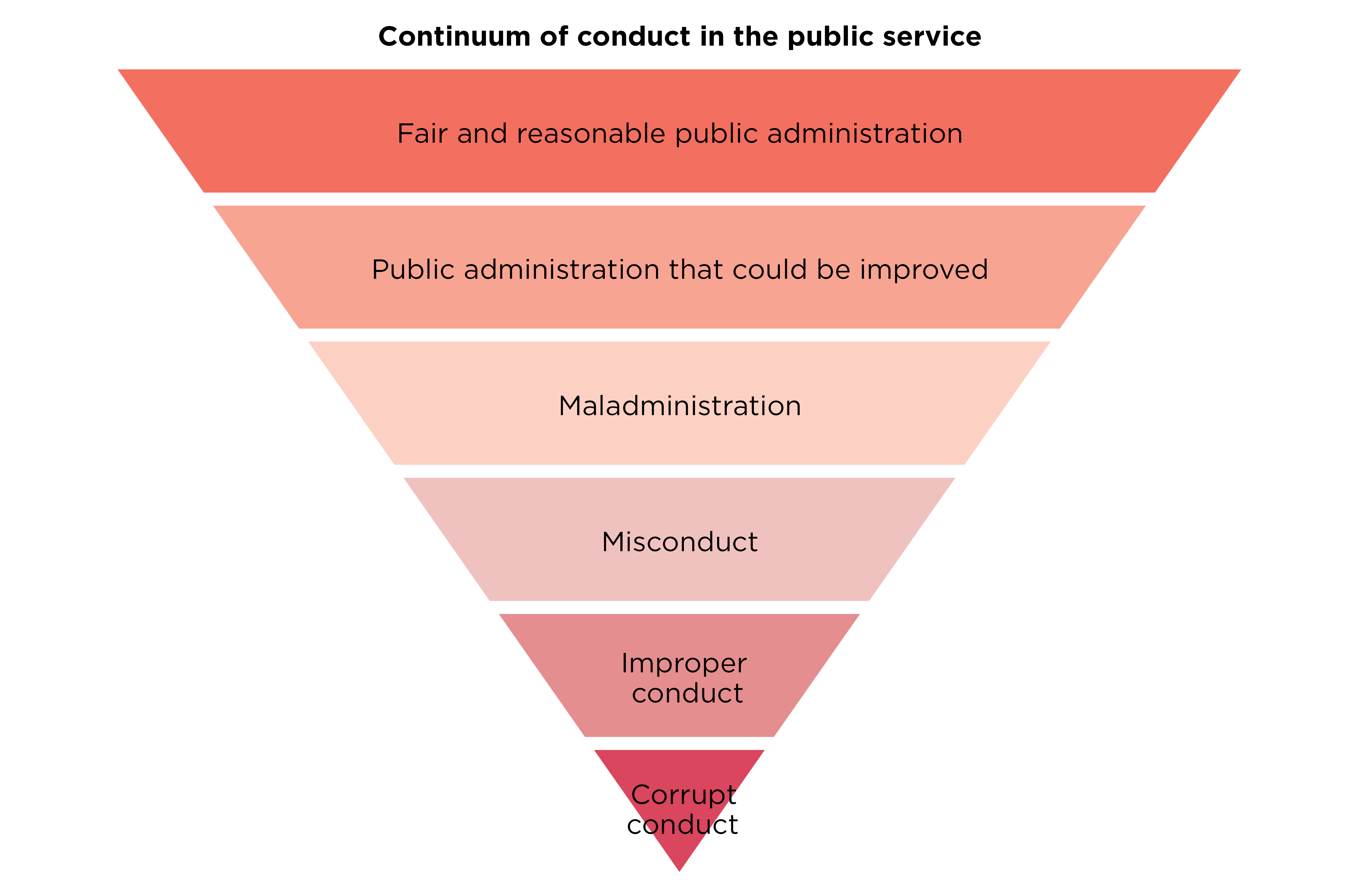
Our jurisdiction spans a broad continuum of conduct, ranging from honest mistakes and poor service to systemic maladministration, human rights breaches and corruption. To be effective, our approach must be equally diverse: flexible, proportionate and tailored to the nature and seriousness of the issue, with prevention strategies that reflect this spectrum.
Our six modes of working
Delivering effective prevention requires a range of tools and responses tailored to different contexts, issues and audiences. We approach prevention through six core modes of working, reflecting how we operate across teams to add value and help shape a fairer Victoria.
Identify
We detect emerging issues, risks and patterns of maladministration through complaint trends, other intelligence and stakeholder feedback. By identifying problems early, we can intervene before harm is done and guide public bodies toward improvement.
Engage
We connect with stakeholders, public sector bodies, and communities to listen, build trust and proactively share insights. Meaningful engagement at all levels ensures our work is responsive, relevant and built on shared accountability for better outcomes.
Understand
We examine not just what went wrong, but why. Our analysis is informed by data, research, and systemic investigation and public policy expertise, allowing us to understand context, root causes and structural barriers to good administration. Understanding context is essential for fair and proportionate oversight and together with engagement, helps us have impact.
Inform
We share what we learn through accessible reports, insights and communications. We inform not only to hold to account, but to inspire reform, demonstrate transparency and promote human rights.
Partner
We collaborate across the integrity landscape and the public sector to support change. By working constructively with others, we avoid duplication and help shape solutions that are practical, sustainable and owned by those responsible for delivering them.
Educate
We build capability and confidence through a broad range of education initiatives. Whether through training workshops, good practice guides, public reports, outreach or communications campaigns, we equip the public sector and community with the knowledge needed to navigate and improve public systems.
Our approach
1. Promote the good
We highlight what good public administration looks like by celebrating fairness, transparency and effective complaint handling. By sharing what works, we help public bodies learn from each other and lift standards across the board.
At the same time, we work to empower equitable participation in public life by recognising the importance of complaints. Through effective complaints, the individual is given a means of more directly and, at times, more powerfully influencing the administration than by casting a vote as one of many in an election.
How we do this:
- Showcase and acknowledge good practice through guidance, reports and case studies.
- Engage with leaders across the public sector to develop trust and share insights and observations without judgement.
- Support cultural change by promoting the return on investment for effective complaint handling.
- Communicate about our work regularly and always with clarity, reach and impact.
2. Prevent the bad
We work alongside public bodies to help them improve their systems, decisions and services. Our work is data-led, risk-based and focused on building capability. By intervening early, we help prevent poor administration and unnecessary complaint escalation, leading to fairer outcomes for the community.
How we do this:
- Deliver targeted training, guidance and support to build capability.
- Provide advice on good administrative decision making.
- Conduct tailored complaint system reviews that promote sustainable continuous improvement.
- Use data and other intelligence to proactively identify emerging risks.
- Produce proactive intelligence reports that turn data into narrative and help the public sector address integrity risks before they become problems.
3. Expose the unfair
When it comes to unfairness and injustice, we believe sunlight is the best disinfectant. We draw on our work to shine a light on significant or systemic failures, not simply to assign blame, but to reveal the causes and consequences of unfairness, amplify unheard voices and humanise the bureaucracy. Transparency holds power, prompting reflection, compelling change and reinforcing public trust.
How we do this:
- Design and produce engaging and accessible publications that reflect the nuance and rigour of our work in complaints, investigations and reviews.
- Conduct public policy research to ensure our findings and recommendations are well informed, contextually grounded and impactful.
- Translate insights and lessons into meaningful tools by publishing good practice guides and policy papers that help public bodies tackle integrity issues proactively and in their own contexts.
Our measures of success
We will know our prevention efforts are working when public bodies seek our guidance and engage early; our proactive interventions have measurable impact; and our education, communications, policy and intelligence products are seen as trusted and valuable resources.
Ultimately, we will measure our success using qualitative and quantitative metrics across four key domains:

As our approach evolves, we will develop and publish more detailed measures.
Our approach to prevention reflects the full breadth of our stewardship role – not only responding to unfairness but actively working to stop it from occurring.
We promote what works, prevent what doesn’t, and expose what harms – helping to build a public sector that is fair, trusted and accountable.
Working collaboratively we seek to ensure our prevention efforts are clear, credible and connected to our operational work, the real‑world challenges of public administration and the expectations of the community.
Our priority projects
Identify | Improve internal data capture and reporting capability to inform operational work. | Develop and embed our approach to intelligence to identify serious and systemic maladministration. | Leverage intelligence to proactively improve public administration. |
| Engage | Embed a routine schedule of meetings with senior stakeholders to share data trends. | Increase engagement with communities experiencing marginalisation, making it easier to complain. | Equip MPs with tools and information to understand complaints in their electorate and help constituents make effective complaints. |
| Understand | Facilitate roundtable discussions to understand key issues and share insights with targeted sectors. | Develop and embed a process for public policy research for oversight work and prevention. | Refine the process for making and monitoring recommendations and informal proposals. |
Inform | Redevelop our website with resources for both the public sector and community. | Identify opportunities to recognise excellence in public administration. | Publish policy papers and intelligence reports on systemic drivers of unfairness. |
| Partner | Develop strategic partnerships to be a trusted adviser on good administration. | Work with other integrity bodies to co-design prevention resources and campaigns. | Develop and maintain partnerships to reach communities experiencing marginalisation. |
Educate | Refresh our approach to education, including our public sector training program. | Develop a community focused education program. | Deliver a forward program of fit-for-purpose good practice guides. |
About our Prevention division
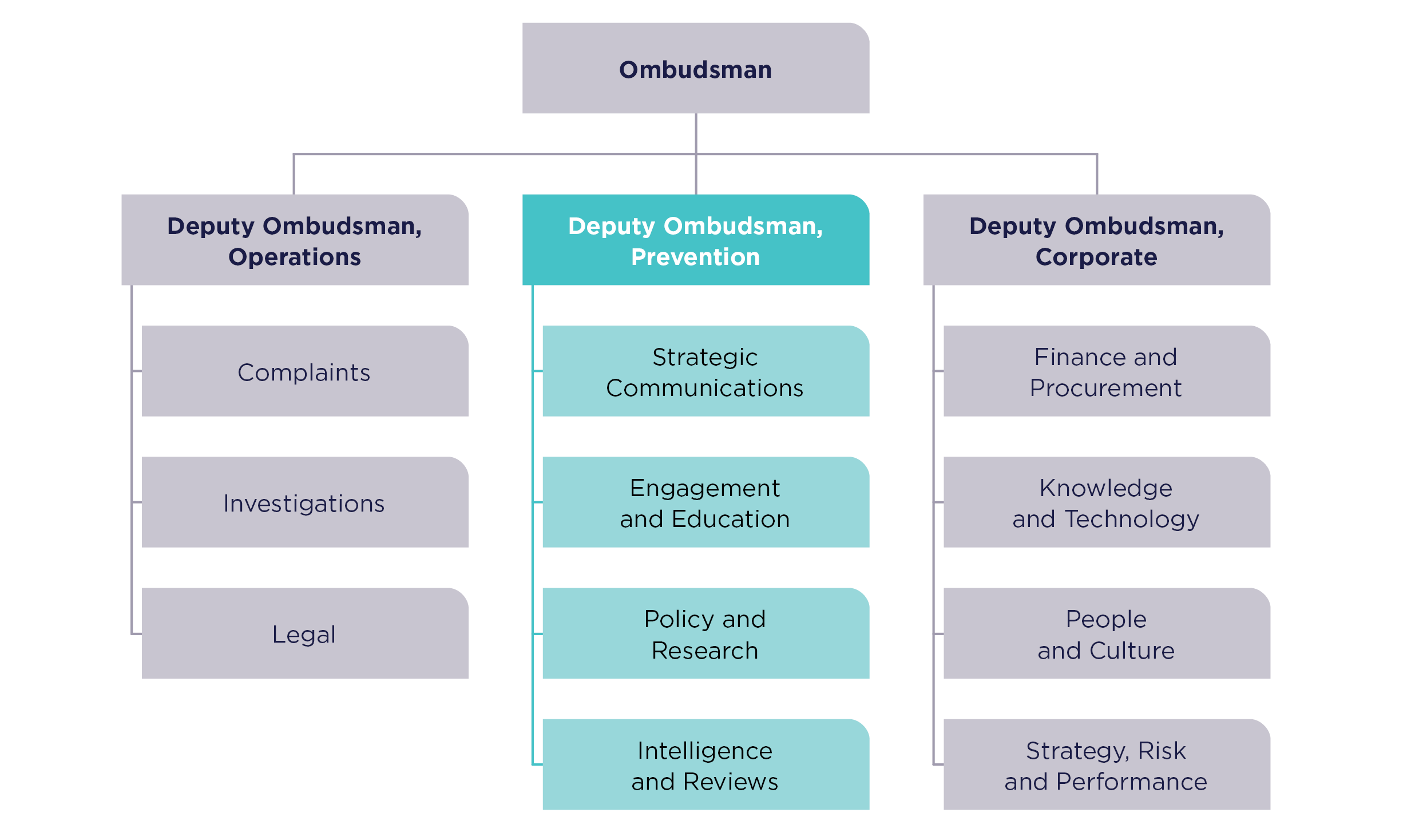
Our Prevention division draws together our Policy, Strategic Communications, Engagement and Education, and Intelligence and Reviews teams to deliver our functions under the Ombudsman Act, which seek to proactively improve public sector administration.
To complement our operations and achieve our legislative objectives, we engage broadly to develop and refine a body of preventive work to:
- identify, expose and prevent maladministration and improper conduct
- assist authorities to improve their administration and complaint handling through reviews of their complaints-handling practices
- educate the Victorian community and the public sector about Ombudsman matters.